Deploying Adaptive AI in Distributed Water Plants
Business Overview
Acciona, a global leader in sustainable infrastructure and water management, relied on laboratory analysis to determine chemical concentrations across its desalination and water treatment facilities worldwide. Because these results took time to obtain, they were often outdated and unreliable by the time they reached operators. This generated additional chemical supply costs and exposed the company to potential regulatory penalties.
To address these challenges, Acciona launched a global digital transformation initiative to modernize its desalination and water treatment operations across more than 40 countries and 5 continents through Edge AI and distributed industrial Edge Computing. The company aimed to optimize chemical consumption, improve operational efficiency, enable real-time predictive intelligence, and centralize the monitoring of highly distributed infrastructure worldwide.
To make this possible, Acciona turned to Barbara and deployed a scalable Edge AI and Edge Computing architecture that streamlined the deployment, execution, and autonomous optimization of industrial applications and Machine Learning algorithms directly at the edge.
Challenges
Acciona's operations spanned more than 40 countries and faced a combination of technical and operational hurdles that traditional approaches could not solve. The four key challenges were:
- No real-time visibility into chemical compositions: Chemical concentrations could only be determined through slow laboratory analysis, so results were often outdated and unreliable by the time they reached operators.
- High operational costs and regulatory risk: Without precise, real-time control over reagent dosing, chemical consumption was suboptimal, generating significant costs and exposing the company to regulatory penalties.
- Global scalability across heterogeneous infrastructure: Any solution needed to work consistently across hundreds of plants in more than 40 countries, despite their diverse equipment, protocols, and operating environments.
- Complex AI model lifecycle management at scale: Deploying, updating, and fine-tuning AI models across a globally distributed fleet required centralized remote management capabilities that traditional systems could not provide.
Solution
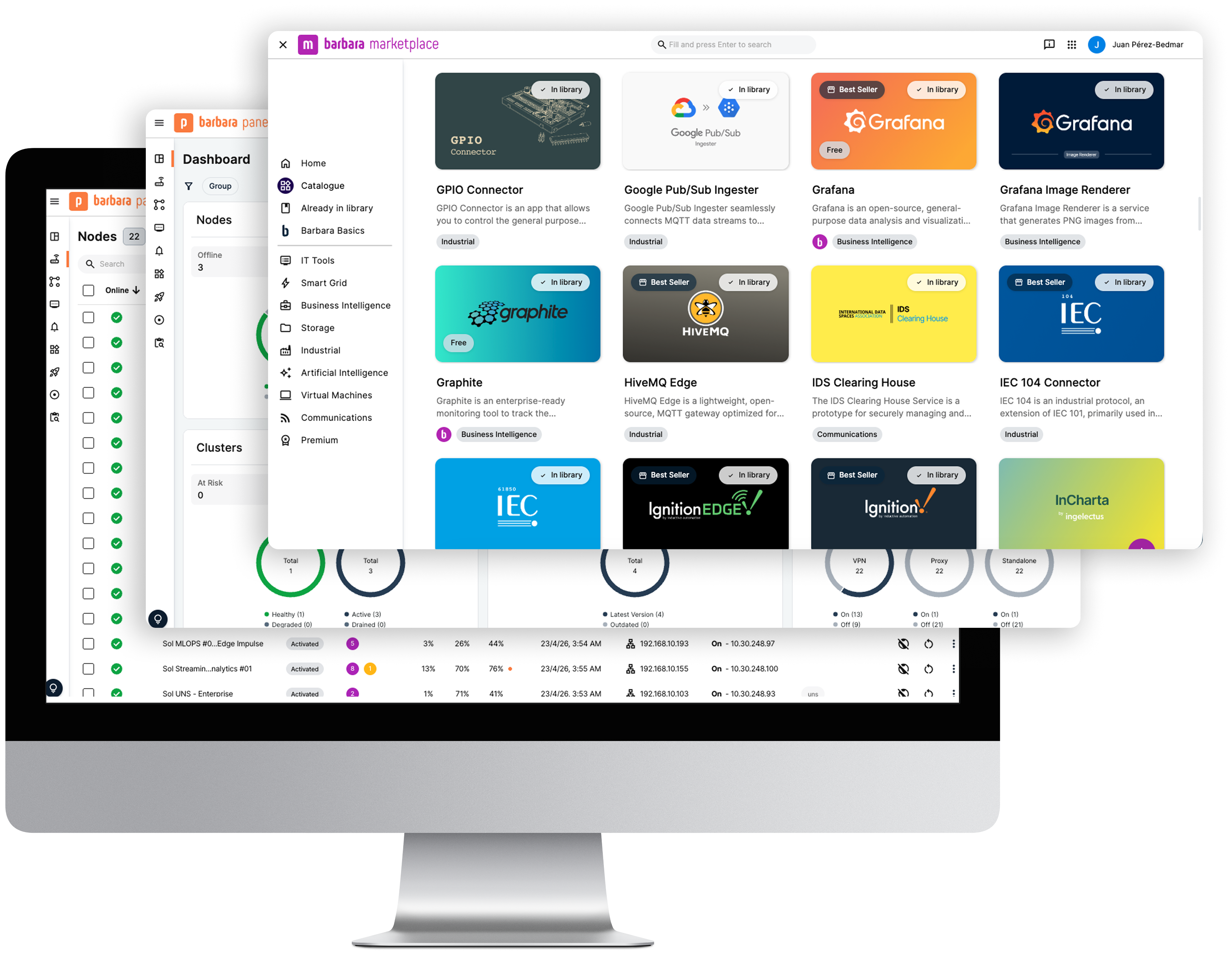
To overcome the limitations of traditional water management approaches, which relied heavily on manual intervention alongside sensor and SCADA systems, Acciona deployed an Edge AI architecture using Barbara Core, Barbara Panel, and Barbara Marketplace. Barbara Core was installed on edge nodes at each water treatment plant, providing a secure, managed runtime for all local applications and maintaining continuous communication with Barbara Panel. Many of the workloads deployed across the fleet came from Barbara Marketplace, where certified industrial applications are available off-the-shelf and ready to deploy at scale.
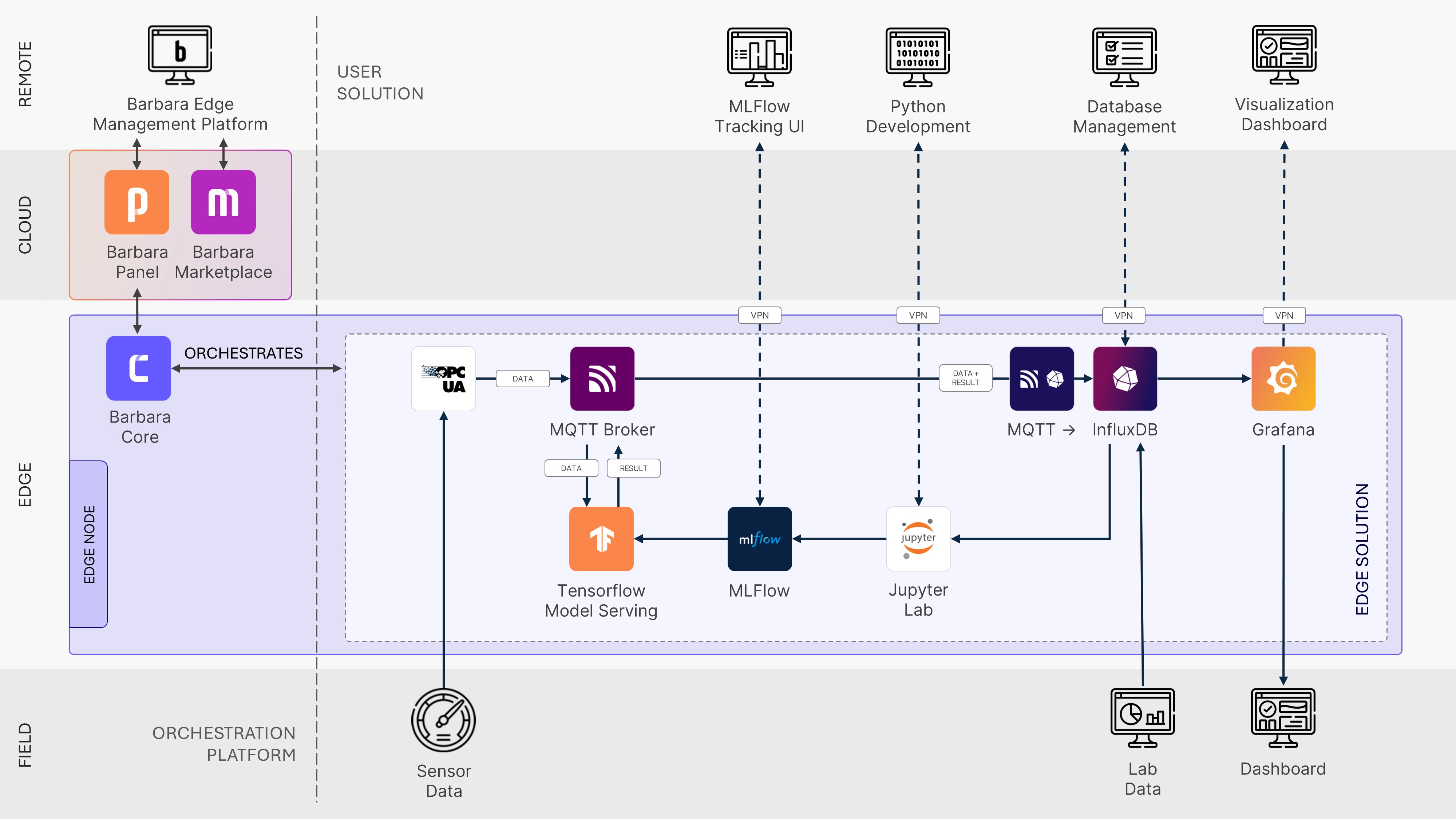
The architecture was organized into two layers:
Edge Layer
Each edge node ran Barbara Core alongside a set of applications deployed and managed remotely through Barbara Panel. The key components deployed at the edge were:
- OPC UA Connector: Collected operational data from local PLCs and sensors in real time, including temperature, pressure, flow, vibration, and machine states, and made it available to the rest of the architecture.
- MQTT Broker: Received data from the OPC UA Connector and distributed it simultaneously to all subscribing services, allowing storage, processing, and visualization components to consume the data independently.
- InfluxDB Ingestor: Consumed MQTT messages and wrote the telemetry to InfluxDB for persistent storage.
- InfluxDB: Served as the local time-series database, storing real-time and historical sensor data to support trend analysis, monitoring, and model training.
- Grafana: Connected to InfluxDB to provide operators with real-time dashboards displaying live process data, alarms, trends, KPIs, and AI-generated insights.
- MLflow: Managed the complete machine learning workflow, including experiment tracking, model versioning, and deployment orchestration. Data stored in InfluxDB was used to train machine learning models, which were then deployed back to the edge node through TensorFlow Model Serving. Once running, each model received live sensor data from the MQTT Broker, performed local inference, and returned its results to the pipeline. Raw data and AI-generated outputs were then combined and sent to InfluxDB and Grafana for storage and visualization.
- TensorFlow Model Serving: Executed the AI models locally on Barbara Core, receiving live data from the MQTT Broker, running inference in real time, and returning the results to the pipeline without relying on external computing infrastructure.
- Jupyter Lab: Enabled custom Python code to run within the edge environment, allowing data scientists to customize model training and monitoring processes directly at plant level.
Cloud Layer
Barbara Panel provided centralized remote management of the entire edge fleet. Through its dashboard, administrators deployed applications, updated configurations, monitored device health, and managed the complete lifecycle of machine learning models across all plants without requiring on-site visits. Barbara's built-in VPN service enabled secure remote access to the web interfaces of workloads running directly on the edge devices.
Results
By using Barbara's platform, Acciona achieved significant operational and financial impact across its global water treatment operations:
- Real-time prediction and monitoring of water chemical values across all facilities from a single central location, eliminating dependence on slow laboratory analysis.
- Hundreds of plants across 40+ countries unified under a single infrastructure: Plants running diverse equipment and protocols were brought under centralized monitoring and management through Barbara Panel, giving Acciona consistent operational visibility across its entire global fleet.
- Over $70 million in savings during the first three years across its 89 desalination plants, driven by optimized reagent dosing and reduced regulatory penalties.
- 800% acceleration in the go-to-market time for new AI models, enabled by Barbara's remote and automated management of distributed application deployments. While 86% of organisations take between one month and one year to deploy their models in the field, Acciona completed deployments within days.
Testimonial
"Barbara's platform stands out as the most advanced and stable of all those we have tested. It is continuously evolving, with new features that improve the overall user experience on a daily basis."
— Alejandro Beivide, Digital Transformation Director, Acciona
Conclusions
By deploying real-time Machine Learning control algorithms across its desalination plants using Barbara's platform, Acciona significantly reduced the use of reactive chemicals while modernizing critical industrial infrastructure worldwide. The initiative established a secure, scalable, and AI-ready foundation capable of supporting future smart water management, predictive maintenance, energy optimization, and industrial automation strategies across Acciona's global operations.
This transformation also delivered substantial improvements in operational efficiency by reducing costs and minimizing regulatory risks. In 2024, Barbara received the IoT Solutions World Congress Award for Best Energy & Utilities Solution for this project, which generates savings of more than €250,000 per plant annually across hundreds of facilities worldwide.
About the Company
Acciona is a global leader in sustainable infrastructure solutions across water, renewable energy, construction, services, and concessions. Operating in more than 40 countries across 5 continents, the company employs over 45,000 people and brings more than 85 years of experience in delivering sustainable infrastructure worldwide.
Acciona has consolidated its position as a key player in the water treatment industry through the design, construction, and operation of advanced drinking water, wastewater treatment, reverse osmosis desalination, and water reuse facilities. The company currently provides water solutions benefiting more than 100 million people in over 30 countries.