Real-Time AI for Pyroprocess Optimization
Business Overview
Argos, one of the largest cement producers in the Americas, set out to achieve carbon neutrality. To reach this goal, the company defined a roadmap that required profound changes in operational efficiency, emissions reduction, and the adoption of advanced industrial technologies.
Most of this challenge was concentrated in the pyroprocess, the high-temperature stage in which raw materials are transformed into clinker inside the kiln. Producing one ton of clinker requires between 3 and 6 gigajoules of energy, and energy costs account for up to 40% of total production costs. A single cement plant can produce up to 5,000 tons of clinker per day, consuming approximately 250,000 litres of fuel daily.
Recognizing the pyroprocess as a critical lever for achieving its decarbonization targets, particularly as carbon pricing increased and pressure to reduce industrial emissions grew, Argos turned to Barbara. The company deployed a real-time AI solution capable of optimizing kiln control directly at the edge.
Challenges
The traditional response to improving pyroprocess control had been to introduce more rules, tuning, or supervision. However, this approach quickly reached its limits. Argos faced three fundamental challenges:
- Rule-based systems could not capture the dynamic complexity of the process: More than 30 variables interacted in highly non-linear and interdependent ways, making it impossible for a set of rules to optimize kiln behaviour reliably.
- Operations depended heavily on manual interventions: Operators continuously adjusted the process based on experience, introducing variability and making performance dependent on individual judgement rather than systematic optimization.
- Cloud-based approaches were fundamentally incompatible with the process dynamics: Critical changes in the flame or kiln load occurred in fractions of a second, while cloud latency introduced response times of several seconds. This made cloud-based processing unsuitable for closed-loop control in this environment.
Solution
Using Barbara Core, Barbara Panel, and Barbara Marketplace, Argos deployed a three-layer edge architecture that enabled real-time data acquisition, model inference, and closed-loop control without disrupting existing OT operations. The solution needed to operate reliably under real production conditions while scaling consistently across every plant in the fleet.
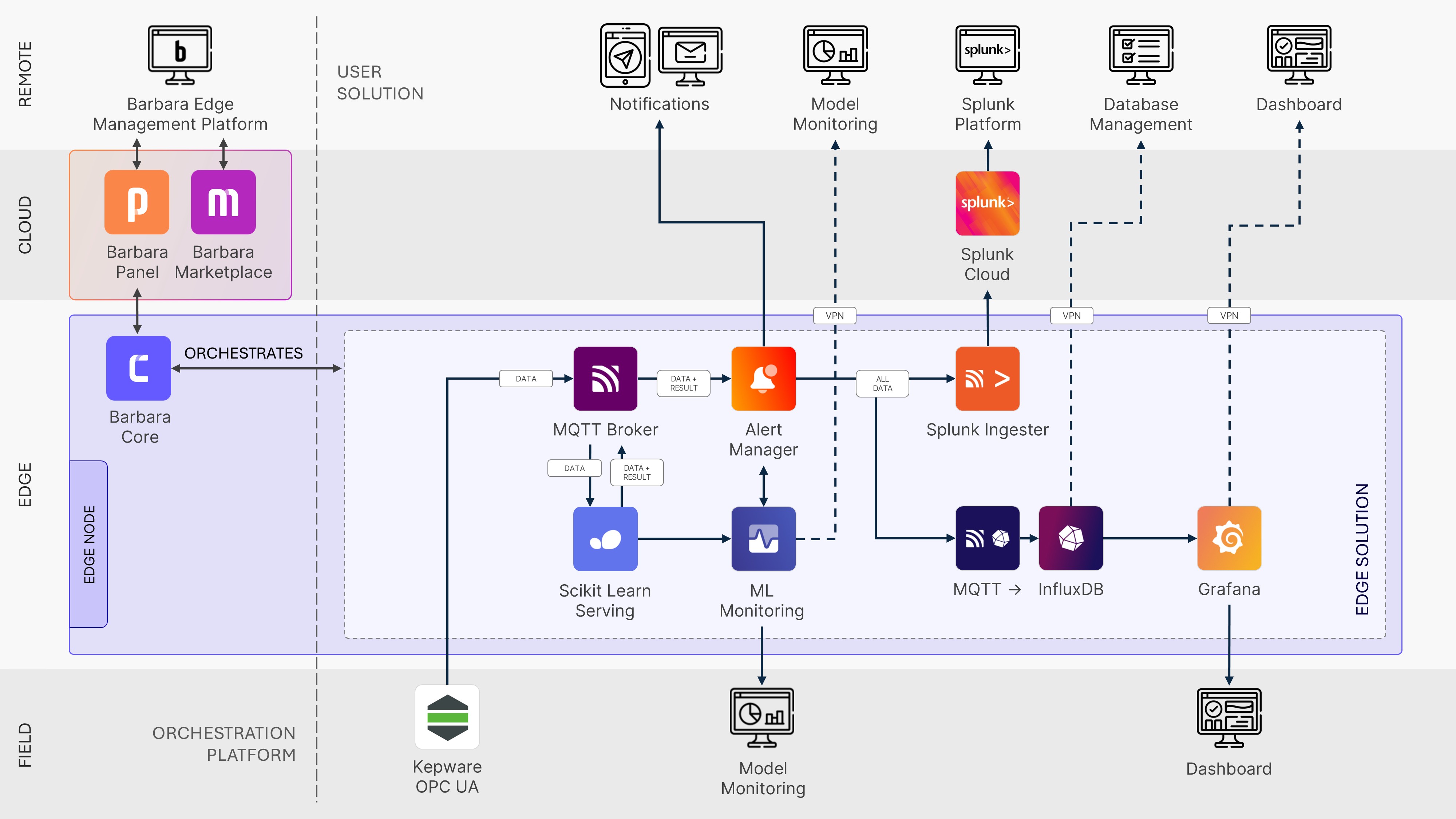
Field Layer (OT Network)
Existing industrial assets, including sensors, PLCs, and control systems operating at Purdue levels 0 to 2, remained completely untouched. Avoiding disruption to existing operations was a key design principle: the architecture connected to these assets without replacing them, minimizing risk and making adoption easier for operations teams. It was also hardware-agnostic and could run on different types of edge devices. At this layer, Kepware OPC UA was configured to read data from PLCs and write it directly to the MQTT Broker on the edge node, bridging the OT environment and the edge computing layer.
Edge Layer
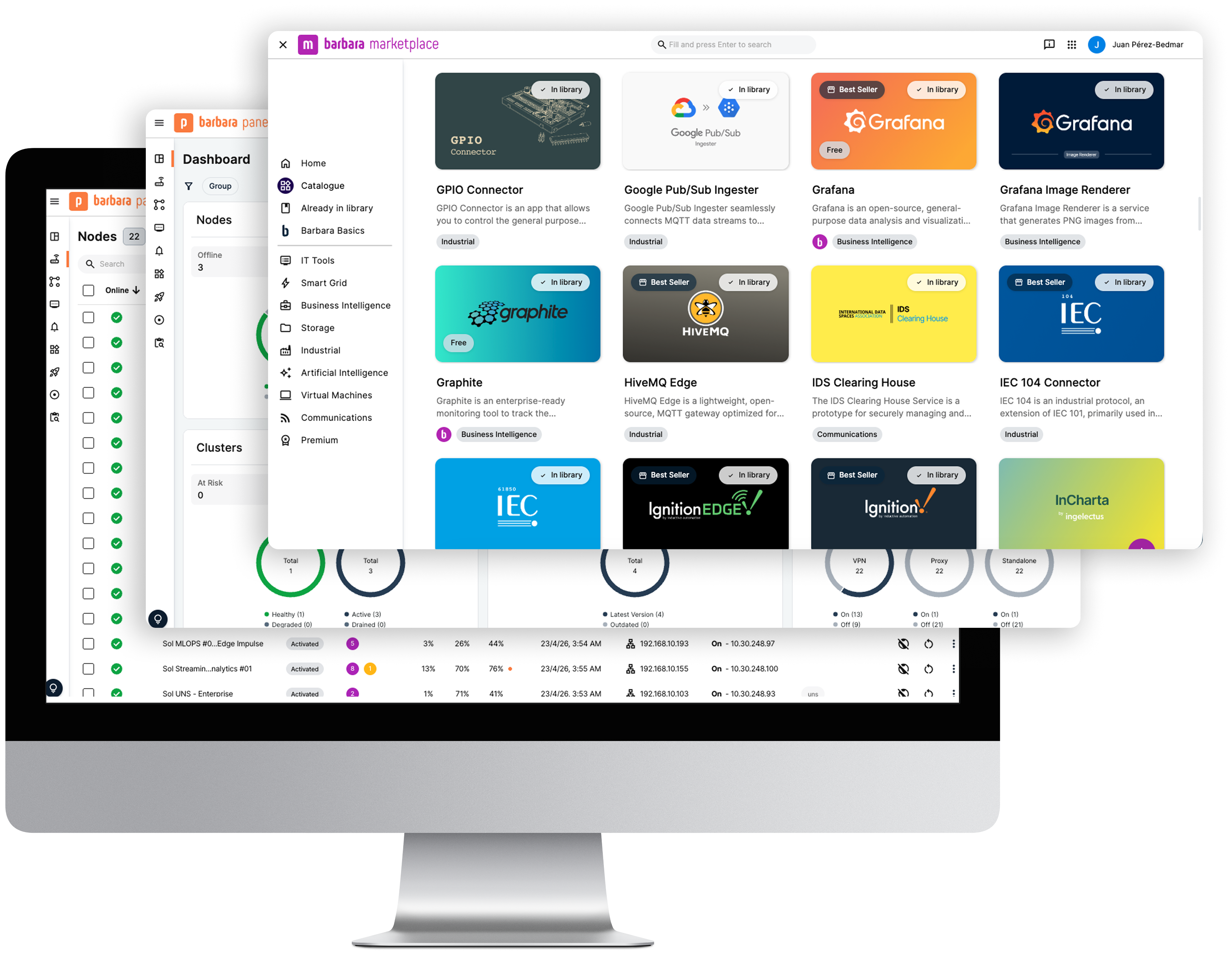
The key transformation took place at the edge. Argos deployed a distributed computing layer at Purdue level 3–3.5, managed with Barbara Core and orchestrated remotely through Barbara Panel. Many of the workloads deployed across the fleet came from Barbara Marketplace, where certified industrial applications are available off-the-shelf and ready to deploy at scale. The key components of the system were:
- MQTT Broker: Created a unified real-time data backbone by receiving data from Kepware OPC UA and distributing it simultaneously to all subscribing services.
- Scikit Learn Serving: Received live process data from the MQTT Broker, ran inference locally in milliseconds, and returned the results to the broker. Raw data and model outputs were then combined and sent downstream for storage, visualization, and alerting.
- ML Monitoring: Used Prometheus to track model performance metrics, including latency and inference counts, and triggered configurable alerts when thresholds were exceeded. This helped ensure that the model continued to operate reliably in production.
- Alert Manager: Received the combined data and model outputs from the MQTT Broker and triggered notifications when it detected anomalies or failures.
- Splunk Ingester: Collected all data flowing through the edge and sent it to Splunk Cloud through Barbara's built-in VPN service. This provided secure remote access to the corporate analytics environment without exposing the OT network.
- InfluxDB: Served as the local time-series database, storing raw sensor data and model outputs for historical analysis and monitoring.
- Grafana: Connected to InfluxDB to provide plant operators with real-time dashboards showing live process data, model predictions, and KPIs, ensuring transparency and helping to build trust in the AI system.
Together, these components formed a fully containerized, microservices-based architecture that delivered modularity and consistency across plants. All services in this layer were deployed and managed through Barbara Panel, which handled deployment, updates, monitoring, and lifecycle management across the entire fleet.
Cloud Layer (Corporate IT)
The cloud layer was used exclusively for non-real-time workloads, including historical analysis, model training, reporting, and monitoring. Crucially, it did not form part of the control loop.
Results
By using Barbara's edge AI platform, Argos achieved measurable impact across its Digital Manufacturing Initiative:
- 38 control loops automated across multiple plants and grinding stations, demonstrating that the approach could be replicated consistently in different environments.
- Clinker factor reduced by up to 5%, directly lowering CO₂ emissions per ton of cement produced.
- Specific energy consumption reduced by up to 6%, directly reducing both operational costs and environmental impact.
- Production increased by between 2% and 10% by stabilizing the process and reducing the variability introduced by manual interventions.
Testimonial
"One of the aspects I liked the most about Barbara was its hardware agnosticism, both from the capture side with the wide range of supported industrial protocols, and deployment, covering ARM nodes such as Raspberry Pi and Jetson, as well as Intel CPUs, GPUs, and virtual machines."
— Estefan Wolff, Digital Manufacturing Leader, Argos
Conclusions
By deploying real-time AI directly at the edge of its cement plants, Argos transformed the pyroprocess from a manually controlled and variable operation into a systematically optimized one, simultaneously improving energy efficiency, CO₂ reduction, and production throughput. Barbara made this transformation possible at scale by allowing industrial teams to run, manage, and update AI models across a distributed fleet of plants without requiring them to become IT specialists. This kept operations teams focused on what they do best.
By 2025, Argos had expanded this strategy to more than 90% of its plants, covering key equipment across the entire production chain and bringing the company meaningfully closer to its 2050 carbon neutrality objective.
About the Company
Argos is one of the largest cement producers in the Americas. With more than 90 years of history, the Colombian company has established itself as a leading player in the cement industry, becoming the fourth-largest cement producer in Latin America and the third-largest in the United States. Operating in 16 countries with a workforce of more than 4,000 employees, the company continues to expand its global presence while maintaining strong operational performance.
Argos has made sustainability a central strategic commitment, supported by a defined roadmap toward carbon neutrality. Its cement manufacturing operations centre on energy-intensive processes such as the pyroprocess, where energy costs can represent up to 40% of total production costs. This makes operational efficiency and emissions reduction key levers for achieving the company's objective.