Substation Virtualization and Smart Grid Digitalization
Business Overview
Aduriz Distribución, an electric power distribution company with more than 125 years of experience, faced a growing need to advance its digitalization and virtualization strategy in order to modernize grid operations and improve operational efficiency. This transformation required tackling multiple challenges at once: technology integration across heterogeneous infrastructure, cybersecurity in a critical network, real-time data management, and the operation of increasingly intelligent and connected power grids.
To address these challenges, Aduriz turned to Barbara, deploying Barbara's platform across two low-voltage (LV) substations as an initial but strategic step toward building a smarter and more secure grid infrastructure.
Challenges
Aduriz operated a distribution network built on equipment from multiple manufacturers, running different protocols, in environments with limited connectivity. The four key challenges the project had to solve were:
- Heterogeneous infrastructure with incompatible systems: Aduriz's network combined Smilics WiBeee sensors using MQTT, smart meter concentrators based on FTP protocol, and line-breakers using Modbus TCP/IP, each with its own data format and communication requirements. Making these systems work together required a unified data collection layer.
- Cybersecurity exposure across a critical network: as a distribution network operator managing critical infrastructure, Aduriz needed robust protection against cyberattacks and had to ensure that all devices and data transmissions remained resilient to vulnerabilities.
- Lack of real-time data granularity and access: existing systems were unable to collect, store, and analyze operational data in real time at the required level of detail, limiting the ability to monitor grid behavior and respond to incidents quickly.
- Operating in dark edge environments: each LV substation operated with limited or no external connectivity. Any solution had to function autonomously at the edge while also laying the groundwork for integrating distributed energy resources such as solar generation and energy storage.
Solution
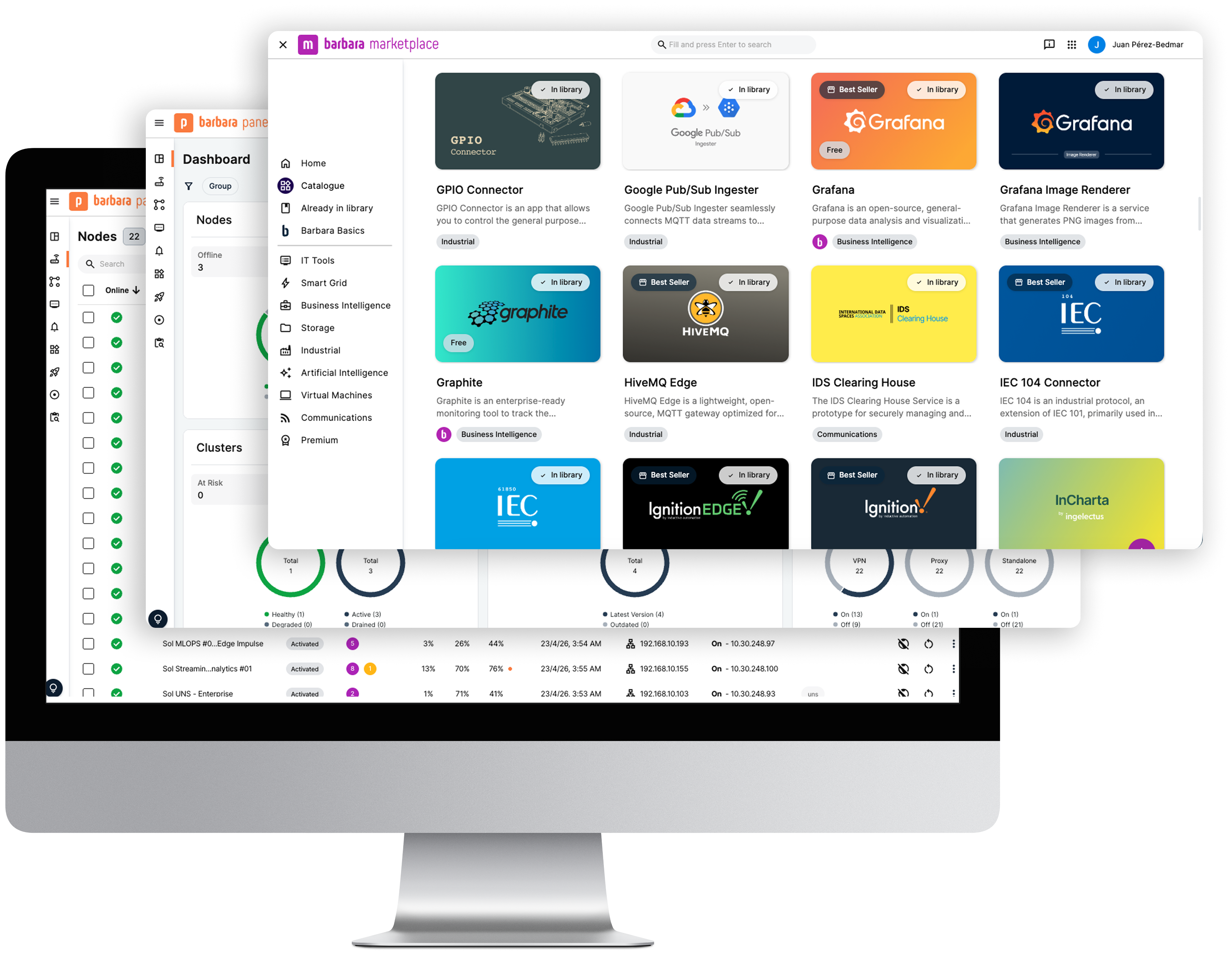
Using Barbara Core and Barbara Panel, Aduriz built an edge architecture designed to evolve progressively from a dark, disconnected environment toward a fully intelligent edge infrastructure. Barbara Core was deployed on edge nodes at each substation, providing the secure runtime for all local applications and maintaining communication with Barbara Panel for remote orchestration and management.
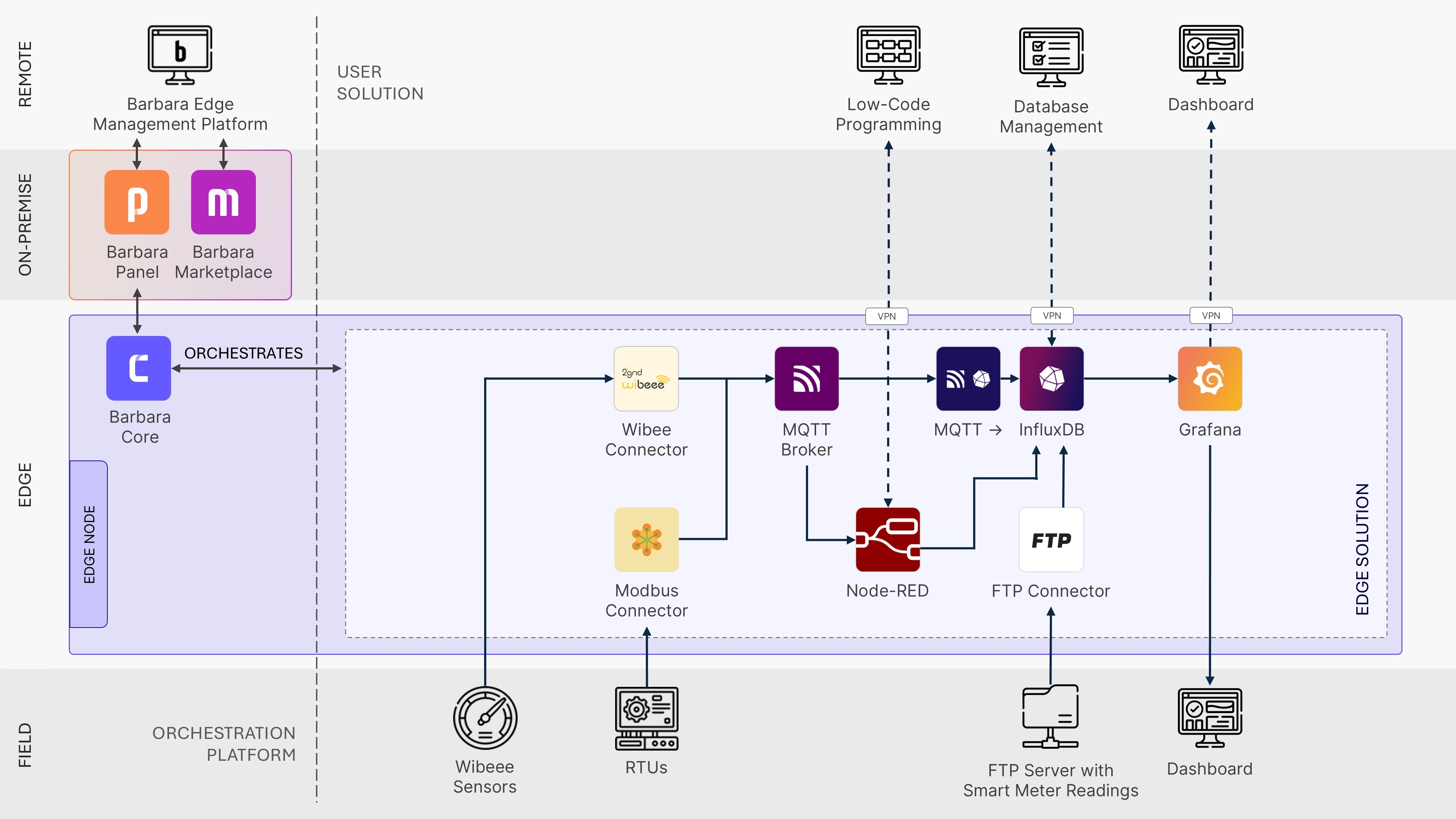
The deployment followed four distinct stages:
From a Dark Edge to a Connected Edge
The first priority was establishing connectivity and data acquisition. The key components deployed at this stage were:
- WiBeee Connector: collected data from Smilics WiBeee sensors through an internal MQTT broker secured with certificates generated by Barbara. Barbara's secrets management functionality allowed certificates to be updated later with credentials selected by Aduriz. The collected readings were then shared through an additional MQTT broker to facilitate integration with the rest of the architecture.
- FTP Meter Concentrator: retrieved meter readings stored in an FTP repository and transferred them to InfluxDB for centralized storage and processing.
From a Connected Edge to an Informed Edge
Once the data acquisition layer was in place, the focus shifted to storing, visualizing, and distributing operational information. The components deployed at this stage were:
- InfluxDB: a time-series database used to store data collected from sensors and meters, enabling both real-time monitoring and historical analysis.
- Grafana: a visualization platform used to create dashboards displaying real-time and historical operational information from InfluxDB.
- Data Transmission layer: operational data was transmitted to Aduriz's central platforms through REST APIs or MQTT protocols, enabling integration with external systems and services.
From an Informed Edge to a Reactive Edge
With monitoring and reporting capabilities in place, Aduriz was able to apply business logic and automate operational workflows using:
- Node-RED: an open-source visual programming platform that simplified the integration of IoT devices and services through no-code workflows. Node-RED enabled Aduriz to automate processes, connect systems intuitively, and react to operational events in real time.
Toward the Intelligent Edge
The ultimate objective of the project was to establish the foundations for an Intelligent Edge infrastructure capable of supporting advanced analytics, automation, and edge intelligence models directly within the substations.
For scenarios where local node configuration was required without relying on Barbara Panel as the remote management interface, Aduriz deployed Barbara SOLO, a deployment model that installs Barbara Panel and Marketplace directly within the client's own on-premises environment, without depending on Barbara's cloud infrastructure. This approach provided greater operational flexibility and autonomy for field deployments.
Results
Using Barbara's platform, Aduriz achieved significant improvements across its substation operations:
- Continuous data streaming from legacy equipment: the infrastructure established uninterrupted data collection from heterogeneous equipment running different legacy protocols, eliminating previous blind spots in grid visibility.
- Enhanced cybersecurity across critical infrastructure: all device communications were secured and certificates managed centrally through Barbara's secrets management functionality, maintaining robust protection across the entire deployment.
- Real-time detection and response to grid events: the edge architecture ensured operational continuity with the ability to detect and respond to incidents in real time, without depending on centralized systems.
- On-premises infrastructure with centralized remote maintenance: the infrastructure was hosted within Aduriz's own facilities while benefiting from remote maintenance and updates managed through Barbara Panel, combining operational autonomy with centralized oversight.
- AI-ready foundation for the Secondary Transformation Centre: the deployment established the infrastructure required to execute and evolve AI models directly within the substations in future phases of the project.
Conclusions
Using Barbara's platform, Aduriz Distribución evolved from fragmented and partially invisible operational environments into a connected, resilient, and intelligent smart grid architecture. By unifying heterogeneous field equipment under a single edge management layer, the project established a secure, scalable, and AI-ready foundation capable of supporting future distributed intelligence and decentralized energy management across the distribution network.
The transformation also strengthened Aduriz's operational posture in two critical areas: cybersecurity across critical infrastructure and service continuity for the communities it serves. As distributed energy resources such as solar generation and energy storage become increasingly prevalent in its network, the edge infrastructure deployed with Barbara gives Aduriz the operational foundation to manage this transition effectively and at scale.
About the Company
Aduriz Distribución is an electric power distribution company with more than 125 years of experience supplying electricity across rural communities in the region of Burgos, Spain.
The company is focused on modernizing its low-voltage infrastructure and advancing smart grid digitalization initiatives to improve operational efficiency, cybersecurity, and service quality. As part of its long-term commitment to innovation and sustainability, Aduriz is driving the integration of new technologies and intelligent grid capabilities across its distribution network.