Unlocking New Value of Manufacturing Machines Through Servitization
.png)
Business Overview
Correa Group is a leading Spanish manufacturer of medium and large-sized milling machines, supplying industries such as aerospace, automotive, and energy in more than 20 countries. For years, the company relied on traditional IoT platforms to monitor its machines, but their limitations soon became apparent. Access to data was restricted, and whenever connectivity was lost, valuable insights disappeared. More importantly, machine data was stored in a vendor's cloud, leaving Correa without true ownership or control over its own operational intelligence.
Determined to transform its operations and move from a hardware-centric model toward a service-driven approach, Correa's innovation team turned to Barbara. Using Barbara's platform, the team began by digitizing its machines and scaled the solution to 70+ units within two years, gaining real-time intelligence, full data ownership, and a future-ready edge strategy.
Challenges
Correa aimed to offer value-added digital services beyond machine sales, including predictive maintenance, remote monitoring, and performance optimization. This ambition exposed four fundamental limitations in its existing infrastructure:
- Restricted data access and fragile connectivity: Traditional IoT platforms limited Correa's access to machine data and offered no resilience when connectivity was lost, causing valuable operational insights to disappear.
- Loss of data ownership: Machine data was stored in the IoT vendor's cloud, leaving Correa without direct access to or control over its own operational data.
- Lack of real-time processing at machine level: Existing PLCs could read data but could not process it locally in real time, limiting the value Correa could extract from it.
- Complex protocol connectivity: Digitizing both new and existing equipment required a secure way to connect to PLCs using different protocols, including the Heidenhain protocol and its strict authentication requirements.
Solution
Correa's innovation team structured the deployment into three phases: digitizing its production machines, building the MY Correa digital ecosystem, and scaling the solution globally across all existing and new equipment.
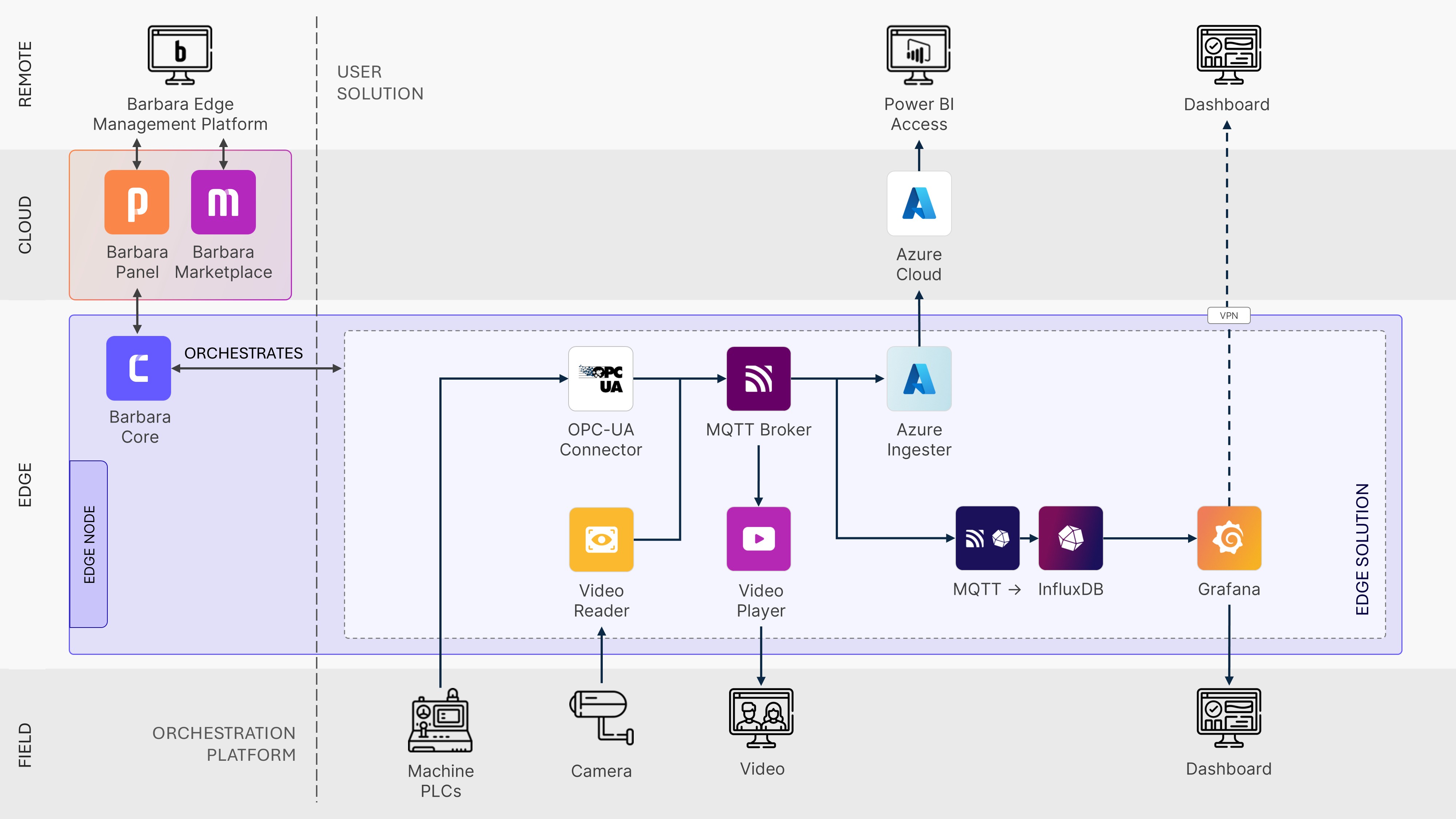
Using Barbara Core, Barbara Panel, and Barbara Marketplace, Correa built an edge architecture organized into two layers:
At the edge
Barbara Core was deployed on an edge node installed on every machine Correa wanted to monitor, providing secure device management and a runtime for all local applications. The key components deployed at the edge were:
- OPC UA Connector: Served as the primary means of collecting data from each machine's PLC and sharing it with the rest of the architecture. A custom connector was developed for machines using the Heidenhain protocol, which required specific authentication handling that standard connectors did not provide.
- MQTT Broker: Acted as the architecture's central messaging backbone, routing data from connected sources to downstream components and supporting seamless data exchange between heterogeneous systems.
- Azure Ingester: Received data from the MQTT Broker and sent it to Azure Cloud for storage and downstream analytics.
- Video Reader: Captured live feeds from cameras installed on selected machines, enabling real-time visual monitoring of machine operations directly at the edge.
- Video Player: Processed and served the stream captured by the Video Reader, allowing operators to view machine activity in real time through a centralized interface.
- InfluxDB Ingestor: Transferred operational data from the MQTT Broker to InfluxDB, making it available for local storage, analysis, and visualization.
- InfluxDB: Stored real-time and historical data collected from the machines, supporting trend analysis, monitoring, and actionable insights for operational improvements.
- Grafana: Connected to InfluxDB to provide Correa's customers with intuitive dashboards for monitoring industrial KPIs, alarms, machine states, and analytical results.
At the cloud
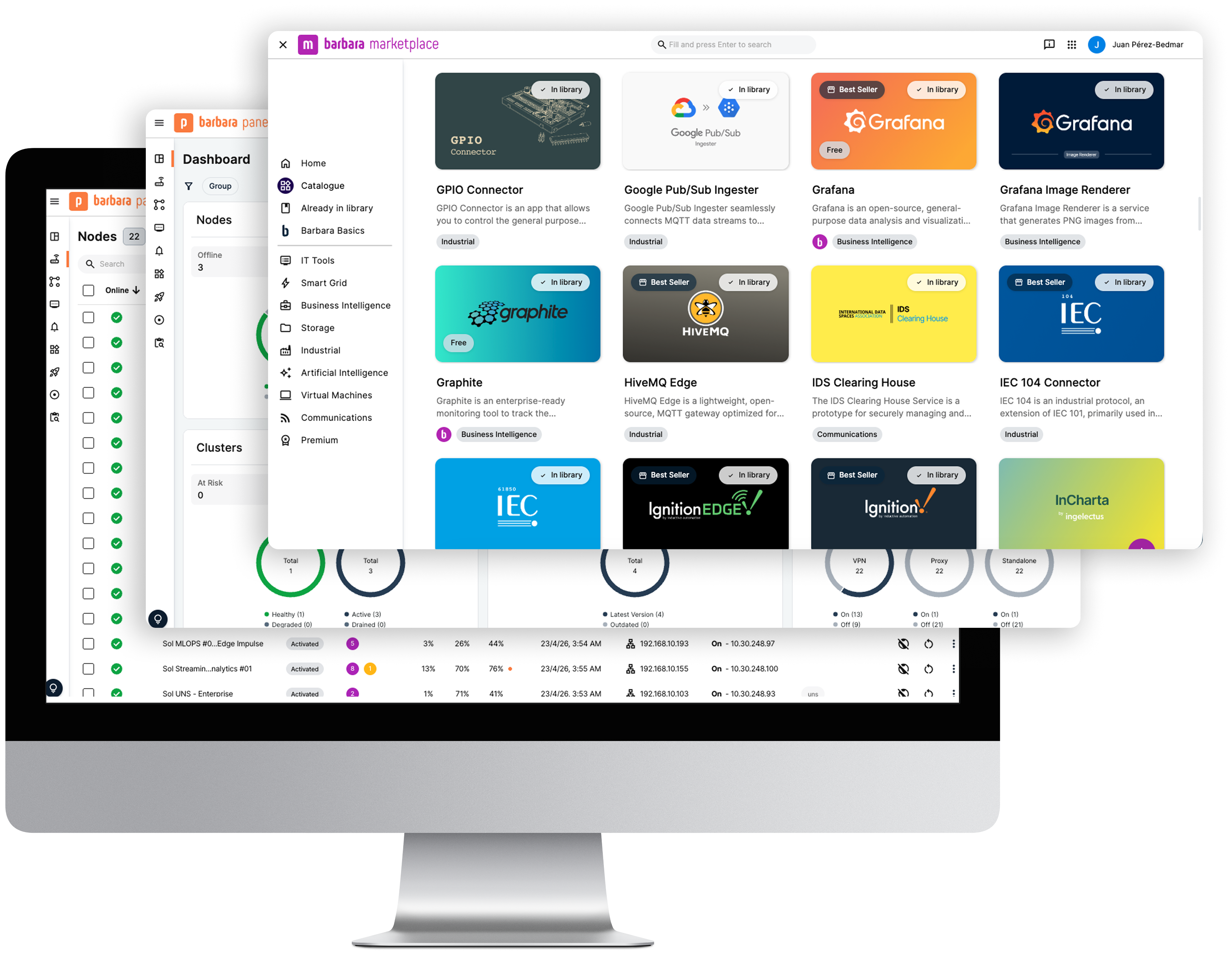
Barbara Panel served as the central orchestration interface, giving the team full remote control of the entire fleet of distributed edge nodes from a single location. Barbara Marketplace provided the catalogue of certified industrial applications from which the team sourced and deployed workloads across the fleet.
Data sent by the Azure Ingester was received by Azure Cloud, where it was converted into Parquet, an open-source columnar format optimized for large-scale data processing. Because Power BI does not work natively with Parquet files, a connector converted the data into SQL for querying and visualization through Power BI, Correa's chosen business analytics and data visualization platform.
Results
Using Barbara's platform, Correa fundamentally changed how it operates and delivers value to its customers:
- Centralized fleet management across 70+ machines: Correa gained remote control and full lifecycle management of its entire machine fleet through a single interface. Data exchange between edge nodes and machines was managed entirely by the deployed applications, supporting secure, autonomous, and independent operations without relying on third-party data handling.
- Scalable application deployment without additional hardware investment: In addition to monitoring machines, Correa deployed and managed applications across its entire fleet, introducing new workloads as use cases and business needs emerged.
- Real-time and historical machine monitoring across all units: Live and historical operational data became available across all monitored machines, supporting informed decisions about performance, maintenance planning, and failure analysis.
- Full data sovereignty enabling new value-added services: With complete ownership of its machinery data, Correa launched new digital services for customers using reliable, first-party operational intelligence rather than vendor-controlled data.
Conclusions
Using Barbara's platform, Correa gained the ability to store, analyse, and process machine data in real time while building a comprehensive historical record for performance optimization and failure analysis. Full control over its operational data, free from vendor dependency, established the foundation on which Correa continues to build its servitization strategy and expand its digital service offering.
Correa evolved from simply monitoring machinery to deploying, orchestrating, and maintaining real-time applications at scale. With Barbara's platform as the central control layer, the company could manage its entire fleet of distributed edge devices through a single interface. It could also independently introduce infrastructure changes, from configuration updates to the deployment of new algorithms, and adapt quickly as its operational needs evolved.
About the Company
Correa is a leading Spanish company specializing in the design and manufacture of medium and large-sized milling machines. It offers a wide range of milling solutions, including bed-type, floor-type, bridge-type, and gantry-type machines, for industries such as aerospace, automotive, energy, and general machining.
Correa has a strong international presence, exporting 90% of its production to more than 20 countries. With offices in Germany, China, India, and the USA, the company provides comprehensive sales and service support worldwide. Its move toward servitization reflects a broader strategic commitment to delivering ongoing value beyond the point of machine sale through digital services that improve performance, reduce downtime, and deepen customer relationships.