Driving Energy Efficiency Globally with Edge Data Storage and Orchestration

Business Overview
GBfoods, a global player in the food and beverage industry, launched a digitalization program to decarbonize its operations. One of its central initiatives was to optimize resource use, minimize its carbon footprint, and reduce energy costs. Achieving this ambition required something the company did not yet have: visibility into how energy was actually consumed across its 19 factories in Europe and Africa.
These plants generated vast amounts of data through equipment, sensors, field systems, and databases. However, the information was locked behind a heterogeneous mix of industrial protocols and could not be accessed remotely. Without detailed consumption data from operational processes, GBfoods could not pinpoint where efficiency improvements were possible. The traditional SCADA approach offered no practical way to collect this data consistently across facilities spanning two continents.
With innovation and sustainability at the heart of its strategy, GBfoods partnered with Barbara and AVEVA to implement an edge infrastructure capable of capturing and storing plant data at source. The infrastructure could be managed remotely across every site while complying with the most stringent industrial cybersecurity requirements.
Challenges
Collecting energy data consistently across 19 factories built at different times, with different equipment and varying levels of automation, presented several obstacles:
- Heterogeneous data sources and protocols: Each factory generated data through equipment, sensors, field systems, and databases using different industrial protocols. There was no unified way to extract and process this data securely.
- No visibility into energy consumption at process level: Without detailed consumption data from operational processes, the company could not identify potential efficiency improvements or optimize energy use.
- A SCADA-centric architecture that could not scale: Traditional SCADA systems lacked the flexibility to incorporate new data sources and required physical intervention for every change, making them impractical for plants distributed across two continents.
- Exposure of IT/OT communications across a global footprint: Connecting operational data to corporate systems at every plant multiplied the points of exposure. The resulting architecture therefore needed to comply with IEC 62443-4-2 from the outset.
Solution
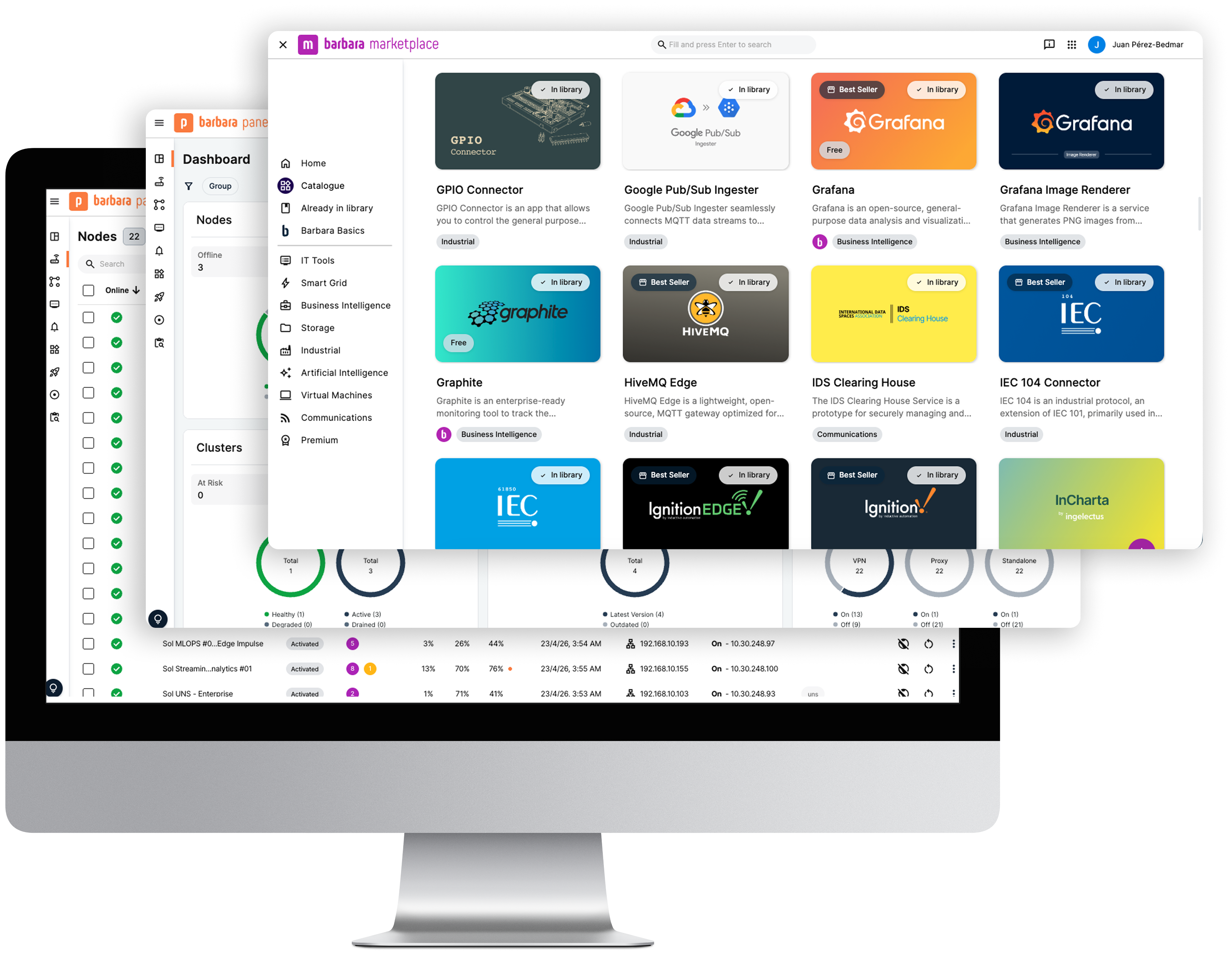
GBfoods deployed a hybrid architecture combining AVEVA's edge-to-cloud data stack with Barbara's edge management and orchestration. The company adopted this approach as an alternative to the traditional SCADA architecture for collecting plant data. Barbara Core was installed on the edge node at each factory, providing the cybersecure operating system and runtime for the containerized data application. Barbara Panel gave the central team a single point of control from which to provision the nodes and remotely deploy, configure, and update the applications running across all 19 sites. The AVEVA application deployed on these nodes came from Barbara Marketplace, where it is available off the shelf as a certified application. This meant that no custom packaging or integration work was required to roll it out across the fleet.

The main components of the deployed architecture were:
- AVEVA Edge Data Store: Ran on the edge node at each factory as the solution's local data layer. It collected data directly from sensors, PLCs, and other plant-floor equipment through its built-in OPC UA and Modbus connectivity, then stored it locally before sending it upstream. Capturing and storing data at the edge allowed collection to continue independently of the cloud connection and ensured that only relevant information travelled beyond the plant.
- CONNECT Data Services: Served as AVEVA's cloud data platform, formerly known as AVEVA Data Hub, and received the data collected at every factory. It consolidated energy consumption data from the entire manufacturing footprint and made it available to the AVEVA Platform tools used by GBfoods' teams for analysis.
Three characteristics of Barbara Core made this architecture viable at scale. Its hardware-agnostic design abstracted the complexity of working with different hardware platforms, allowing the same setup to run on any available ARM or Intel x86 device at each site without custom integration. Its out-of-the-box compliance with IEC 62443-4-2 secured communications between IT and OT systems across the entire infrastructure, avoiding the additional hardening and configuration effort that this requirement would normally demand. Finally, its Standalone mode allowed each node to be managed from within the plant. Technicians retained local access for commissioning and on-site interventions, including access to a network configuration portal from the local network, without relying on a connection to Barbara Panel.
Results
The architecture has already transformed how GBfoods collects and manages plant data:
- All 19 factories equipped with a common data infrastructure: Every plant in Europe and Africa now captures and stores process data through the same standardized edge architecture, giving the company the tools to analyse energy use and act on its findings.
- On-site interventions minimized: Remote deployment, configuration, and updating of data applications removed the need to travel to each site, reducing costs and accelerating the rollout of changes and updates across all plants.
- A single secure path between OT and IT: Consolidating data collection within one IEC 62443-4-2-compliant architecture reduced points of exposure and protected communications between plant systems and corporate platforms.
- A silo-free foundation reusable beyond energy: Because data is collected once and made available centrally, new use cases can be built on the same infrastructure without further investment in connectivity or hardware.
Testimonial
"We have successfully equipped all our factories with the necessary tools to analyze and identify efficiencies and to implement improvements based on reliable data"
— Oriol Mesia, IT Digital Hub Manager, GBfoods
Conclusions
By replacing a SCADA-centric approach with an edge architecture managed through Barbara's platform, GBfoods transformed data collection from a plant-by-plant project into a standardized capability available across all 19 factories. The company now has the reliable process data needed to identify and address inefficiencies, supported by infrastructure that can be extended to new sites and applications without redesigning how data is captured.
This foundation directly supports GBfoods' decarbonization objectives by providing the visibility into energy consumption that was previously missing while protecting communications between OT and IT systems under IEC 62443-4-2. Beyond energy, the same architecture can support future data-driven use cases across the company's operations in Europe and Africa, without further investment in the underlying infrastructure.
About the Company
GBfoods is a leading company in the consumer goods industry, headquartered in L'Hospitalet de Llobregat (Barcelona). It employs more than 3,600 people, operates manufacturing facilities in 19 locations, and has a strong presence across 50 countries in Europe and Africa, with a portfolio of 30 leading local brands.
For more than 80 years, GBfoods Spain has innovated and transformed Spanish kitchens through iconic brands such as Gallina Blanca, Yatekomo, and El Pavo. Its products and categories, including broths, cooking bases, and Avecrem, have become staples in households across Spain.