Smart Water Operations through Edge Computing
Business Overview
GS-Inima Environment, headquartered in Madrid, is a global leader in water and environmental solutions, operating desalination, wastewater treatment, and renewable energy infrastructure across several continents.
Across this network of facilities, the company faced a familiar but daunting challenge: operational data was fragmented and locked inside a wide variety of SCADA systems that differed from one facility to another. Historical trends were impossible to analyse and, without a unified view, the company could not fully understand energy usage, seasonal fluctuations, or system performance. With more than 200 water treatment projects across 12 countries, any solution needed to connect these diverse systems, standardize data flows, and lay the groundwork for future AI capabilities.
To achieve this, GS-Inima turned to Barbara and built an edge computing infrastructure capable of reading data directly from plant equipment, processing and storing it locally, and publishing it to a single centralized stream shared across all connected sites.
Challenges
Moving from siloed data to distributed intelligence required GS-Inima to solve three problems that its existing systems could not address:
- Data locked inside heterogeneous SCADA systems: Operational data was fragmented across a wide variety of SCADA systems that were not designed to share information, leaving the company without a unified view of its facilities.
- No historical record to analyse: The installed systems made it difficult to collect, unify, and retain data over time. As a result, GS-Inima could not analyse historical trends or properly understand energy usage, seasonal fluctuations, and system performance.
- Heterogeneous infrastructure spread across continents: The plants in the portfolio relied on diverse systems built at different times and by different vendors, with no standardized data flows between them or common foundation on which to build future AI capabilities.
Solution
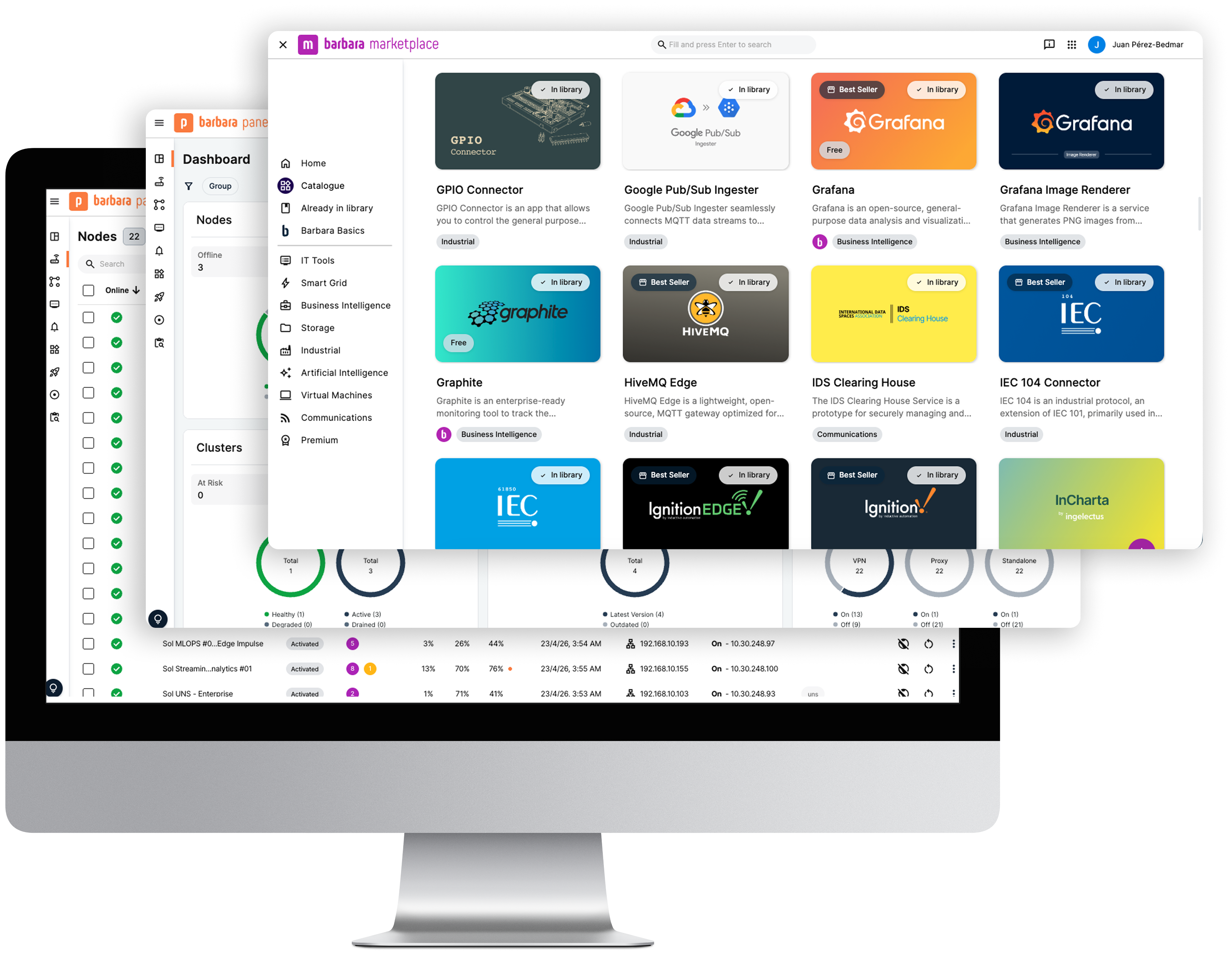
To bring its plant data under control, GS-Inima built a secure, scalable edge infrastructure using Barbara Core and Barbara Panel. Barbara Core was installed on the edge nodes, providing the cybersecure runtime for all local applications and maintaining continuous communication with Barbara Panel. From Barbara Panel, GS-Inima could orchestrate devices and deploy applications remotely. Many of these workloads came from Barbara Marketplace, where certified industrial applications are available off-the-shelf and ready to run at the edge.
Every application at the edge ran as an independent microservice, making the system modular, flexible, and easy to update or scale. This principle shaped the entire architecture. Rather than replacing the existing SCADA and control systems, each edge node operated alongside them, reading the data they already produced and converting it into a standardized flow. The same architecture could then be replicated at any other facility, with data sent upstream to a common destination.
.png)
Field Layer
The edge nodes interfaced directly with existing plant equipment, collecting data in real time through standard industrial protocols:
- SCADA systems and Siemens PLCs: Provided process data from the water treatment plant, read over OPC-UA, OPC-DA, or Modbus depending on the case.
- Photovoltaic equipment: Provided data from the renewable generation assets on site, read over Modbus, so energy production could be monitored alongside hydraulic behaviour.
Edge Layer
Each edge node ran Barbara Core together with a set of applications deployed and managed remotely through Barbara Panel. The applications running on the edge nodes were:
- Industrial Connectors (OPC-UA, OPC-DA, Modbus): Read data from production line sensors, SCADA systems, and photovoltaic equipment, then published it to the MQTT Broker for further processing. The three connectors were used interchangeably across the fleet, with each node running the one that matched the protocols exposed by its local equipment. This allowed GS-Inima to apply the same architecture to plants of very different ages and vendors without redesigning the rest of the pipeline.
- MQTT Broker: Managed communication between system components using a publish-subscribe model, allowing the same data to be consumed independently for storage, processing, or visualization.
- MQTT to InfluxDB Ingester: A Barbara-developed application that transferred data from the MQTT Broker to InfluxDB for storage.
- InfluxDB: The local time-series database used to store sensor data and retain the historical trends that had previously been lost.
- Grafana: Connected to InfluxDB to display plant data in operational dashboards, covering everything from hydraulic behaviour to energy production.
- MQTT to MQTT Ingester: Subscribed to the local MQTT Broker and republished the data to a cloud MQTT broker. This carried the information generated at each site beyond the plant boundary, making it available for centralized consumption.
Cloud Layer
Barbara Panel provided centralized remote management of the edge nodes, allowing GS-Inima to deploy applications, update configurations, and monitor device health without travelling to each facility. Barbara's built-in VPN service enabled secure remote access to the web interfaces of workloads running on the edge nodes, allowing plant dashboards to be consulted from outside the facility.
A cloud MQTT broker acted as the meeting point for the entire fleet. Every edge node published its data there, bringing information from plants with different equipment, protocols, and SCADA systems into a single standardized stream. From there, any data consumer could subscribe once and receive information from every connected site instead of integrating with each facility individually. This finally gave GS-Inima the unified view it had been missing, without making the plants dependent on the cloud to continue operating.
Results
In less than 12 months, GS-Inima transformed fragmented plant data into a single real-time view of its operations:
- Edge nodes deployed in Seseña (Spain) and Ensenada (Mexico) in under 12 months, establishing a standardized architecture ready to be replicated across the rest of the portfolio.
- Full visibility into operations and energy usage, with hydraulic behaviour and photovoltaic generation monitored in real time and displayed together in the same dashboards for the first time.
- Historical trends recovered, with plant data retained locally in a time-series database. This made it possible to analyse seasonal fluctuations and system performance over time, which the previous SCADA systems could not support.
- Data from every connected site centralized in a single stream, with each edge node publishing to a cloud MQTT broker. Corporate consumers could therefore subscribe once and receive standardized data from the entire fleet instead of integrating with each plant individually.
Testimonial
"For a long time, we simply didn't have the data or the tools to understand what was going on in our facilities. Our operations rely on a wide variety of SCADA systems, which has made it difficult to collect, unify, and retain data from our installations."
— José María Redondo, Digital Transformation Lead at GS-Inima
Conclusions
By deploying an edge computing architecture with Barbara's platform, GS-Inima established a scalable way to connect diverse systems, standardize data flows, and turn operational chaos into real-time clarity. What began with two edge nodes in Seseña (Spain) and Ensenada (Mexico) became the blueprint for a global rollout extending to Numancia (Spain), Shuweihat (United Arab Emirates), and beyond.
The project also gave GS-Inima the foundation it needed to automate edge intelligence for truly smart water operations. Standardized data flows and locally retained historical trends prepared the company for AI-powered decision-making across its facilities.
About the Company
GS-Inima Environment is a global benchmark in the water sector and a leader in water and environmental solutions. Headquartered in Madrid, the company manages complex infrastructure spanning desalination, wastewater treatment, and renewable energy, with more than 200 water treatment projects across 12 countries.
GS-Inima participates in every phase of the projects it undertakes, including design, technology, construction, financing, operation, and maintenance, whether the source is seawater, brackish water, or industrial and urban wastewater. It is one of the companies with the largest number of plants under concession, and its flagship projects include the Barka V Desalination Plant in Oman and Shuweihat 4 in the United Arab Emirates.