27/5/2024
-
5
min
Edge computing is crucial for most enterprises' digital transformation goals, with projects already underway across various industries and organizations. However, most deployments currently focus on individual use cases, leading to fragmented islands of edge computing technologies, processes, and skills. What should you do when these independent projects start to multiply? We will disclose the answer in this article.
Edge computing is crucial for most enterprises' digital transformation goals, with projects already underway across various industries and organizations. However, most deployments currently focus on individual use cases, leading to fragmented islands of edge computing technologies, processes, and skills. What should you do when these independent projects start to multiply? We will disclose the answer in this article.


Scaling an edge computing project involves expanding the deployment from a limited, controlled environment to a broader, more complex infrastructure.
While few enterprises have edge computing strategies today, 69% of CIOs surveyed said that edge computing is a digital trend they had already deployed or would deploy by mid-2025. ( source Gartner)
At the heart of edge computing are edge servers and gateways that process and store data locally. Scaling requires deploying additional servers and gateways to cover a wider area and manage increased data loads.
Likewise, reliable, high-speed connectivity is essential for communication between edge devices and central systems. Scaling may involve upgrading network components to support higher bandwidth and lower latency.
• Modular Architecture: A modular edge architecture allows for easy scaling. By using microservices and containerization, organizations can add or remove components without disrupting the entire system.
• Cloud Integration: Seamless integration with cloud infrastructure ensures that edge computing resources can be dynamically allocated and managed. This hybrid approach leverages the strengths of both edge and cloud computing.
• Edge AI: Implementing AI at the edge enables real-time data processing and decision-making. Scalable edge AI requires deploying and managing machine learning models across multiple edge devices, ensuring consistency and accuracy.
• Model Training and Updates: Continuous model training and updates are crucial for maintaining the effectiveness of AI applications. Organizations need a strategy for distributing updated models to edge devices efficiently.
• Distributed Data Storage: As the number of edge devices increases, managing data storage becomes more complex. A distributed storage system that can scale horizontally is essential.
• Data Aggregation and Analytics: Real-time data aggregation and analytics capabilities must be scalable to handle the increased volume of data generated by edge devices.
• Data Security: Protecting data at the edge involves implementing robust security measures, including encryption, access control, and regular security audits.
• Regulatory Compliance: Scaling an edge computing project must consider compliance with relevant regulations and standards, such as GDPR for data privacy. This involves managing data residency and ensuring that data handling practices meet legal requirements.
• Deployment Challenges: Managing a large number of edge devices spread across various locations is complex. Ensuring that all devices are correctly configured, updated, and maintained can be a logistical challenge.
Deep dive about: Scaling your Industrial Edge Computing Projects with an Edge Management and Orchestration tool
• Increased Attack Surface: With more devices at the edge, the attack surface expands, making it more challenging to protect against cyber threats. Implementing comprehensive security measures for a larger number of devices is essential but also resource-intensive.
•Data Sovereignty: Different regions may have varying regulations regarding data storage and processing. Ensuring compliance with these regulations while scaling can be difficult and may require significant adjustments to data management practices.
• Compatibility Issues: Many organizations have legacy systems that are not designed to work with modern edge computing infrastructure. Integrating these systems with new edge solutions can be complex and costly.
• Interoperability: Achieving seamless interoperability between various edge devices, platforms, and applications is a significant challenge. Standardizing communication protocols and data formats is necessary but can be challenging in a diverse technological ecosystem.
• Initial Investment: Scaling edge computing requires substantial upfront investment in hardware, software, and network infrastructure. Justifying this investment can be challenging, especially for organizations with limited budgets.
• Operational Costs: Managing and maintaining a large-scale edge computing infrastructure involves ongoing operational costs, including energy consumption, maintenance, and security.
You might be interested in reading more about buy vs build
• Talent Shortage: Edge computing is a relatively new field, and there is a shortage of skilled professionals with the necessary expertise to design, deploy, and manage large-scale edge computing projects.
• Incremental Scaling: Rather than attempting to scale all at once, organizations should adopt a phased approach. Start with small-scale deployments, learn from these implementations, and gradually expand.
• Collaborate with Experts: Partner with technology providers, system integrators, and consulting firms that have experience in edge computing. These collaborations can provide valuable expertise and resources.
• Edge Management Platforms: Utilize edge management platforms that provide centralized control and automation for deploying, monitoring, and maintaining edge devices.
• Security by Design: Incorporate security considerations into the design phase of edge computing projects. Ensure that security measures are scalable and can be adapted as the infrastructure grows.
Learn more about Barbara´s approach to security here:
Despite the challenges encountered, benefits resulting from using edge-based data are already being widely realized by organizations. Most likely cited are better compliance (33%), improved business agility (30%), enhanced data processing speed (30%) and improved latency and real-time responsiveness (30%), among many other benefits. And organizations are anticipating more of the same in the future, which bodes well for continual growth of this emerging technology.
Scaling an edge computing project involves navigating a complex landscape of technological, operational, and regulatory challenges. Overcoming barriers such as infrastructure complexity, security concerns, integration with legacy systems, cost constraints, and skill shortages requires a strategic approach, leveraging partnerships, automation tools, and continuous learning.
.- You will inderstand what drives successful Edge Computing deployments, and identify the right technology and platform.
.- You will discover how companies spanning the energy, manufacturing, and utilities industries have leveraged their own data to improve the performance of their operators and increase reliability.
.- You will explore each stage of a digital journey to build an intelligent edge and grasp the importance of addressing infrastructure requirements early on.
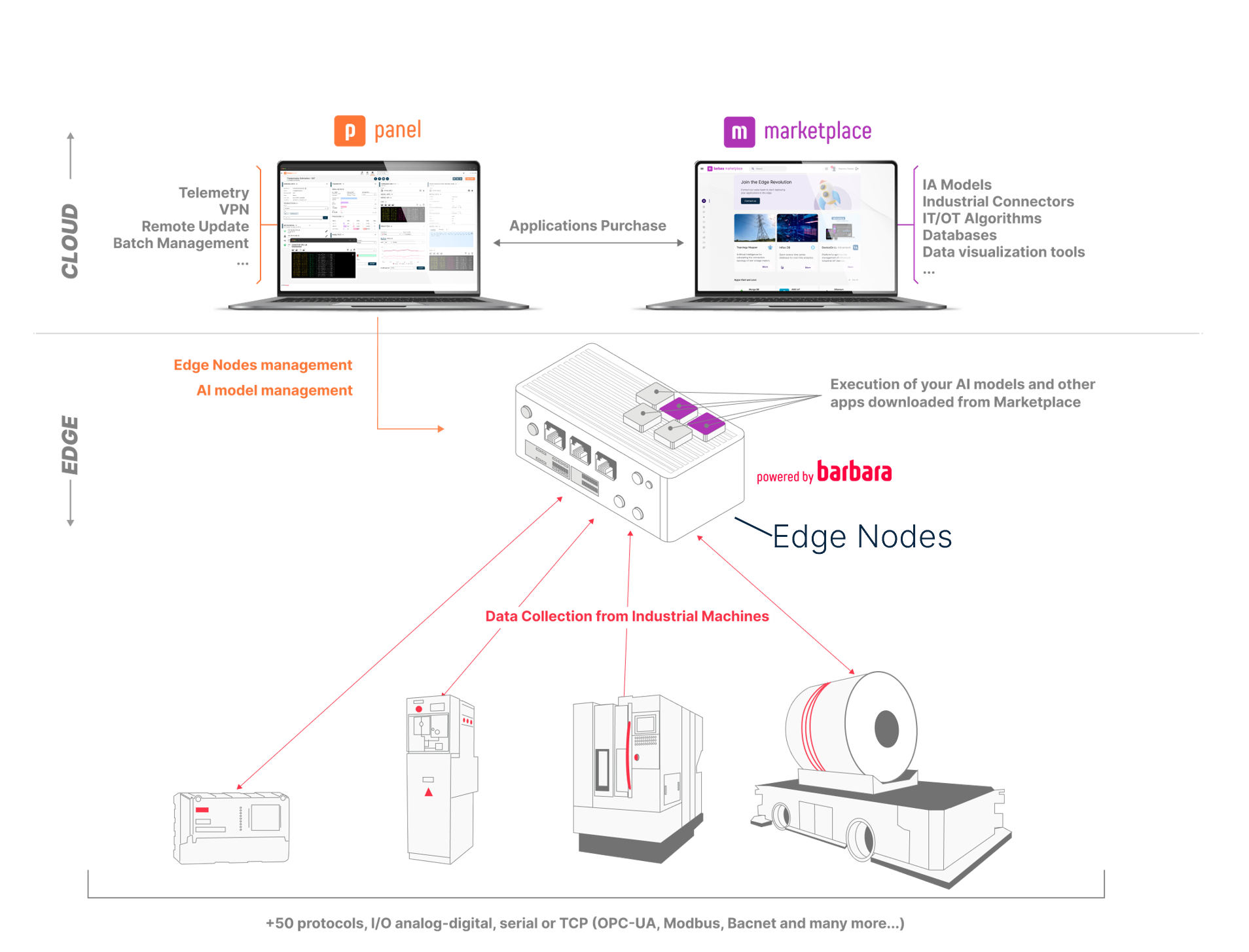
Barbara is at the forefront of the AI Industrial Revolution. With cybersecurity at heart, Barbara is the Edge AI Platform for organizations seeking to overcome the challenges of deploying AI, in mission-critical environments.
With Barbara companies can deploy, train and maintain their models across thousands of devices in an easy fashion, with the autonomy, privacy and real-time that the cloud can´t match.
Barbara´s technology is composed of:
• Industrial Connectors to attach edge devices to any other legacy or next-generation equipment.
• Edge Orchestrator to deploy and control container-based and native edge apps across thousands of distributed locations.
• Device Management to provision, configure, update, operate and decommission Edge Devices cybersecurely.
• MLOps to optimize and package your trained model in minutes.
• Marketplace of containerized Edge applications ready to be deployed. The marketplace includes third-party applications and a suite of Barbara microservices.

Most conversations about Agentic AI in industry start three levels too high: autonomous factories, agents talking to other agents. This is the small version that actually works, five building blocks that let an operator ask the plant a question and get a real answer.
.jpg)
Everyone is chasing generative AI and autonomous agents, but the industrial AI that already delivers, predictive maintenance and computer vision, never left the factory floor. A field reality check on hype versus what actually works, and why the best engineering starts with the problem, not the technology.
.jpg)
Most people in industrial automation still believe that hardware is inherently more reliable than software. But many of the assumptions behind that belief were formed decades ago, before connected operations, edge computing, and software-defined industrial systems became a reality. In this article, we challenge five of the most common myths about software in industrial environments.


