22/7/2026
-
5
min
Everyone is chasing generative AI and autonomous agents, but the industrial AI that already delivers, predictive maintenance and computer vision, never left the factory floor. A field reality check on hype versus what actually works, and why the best engineering starts with the problem, not the technology.
Everyone is chasing generative AI and autonomous agents, but the industrial AI that already delivers, predictive maintenance and computer vision, never left the factory floor. A field reality check on hype versus what actually works, and why the best engineering starts with the problem, not the technology.


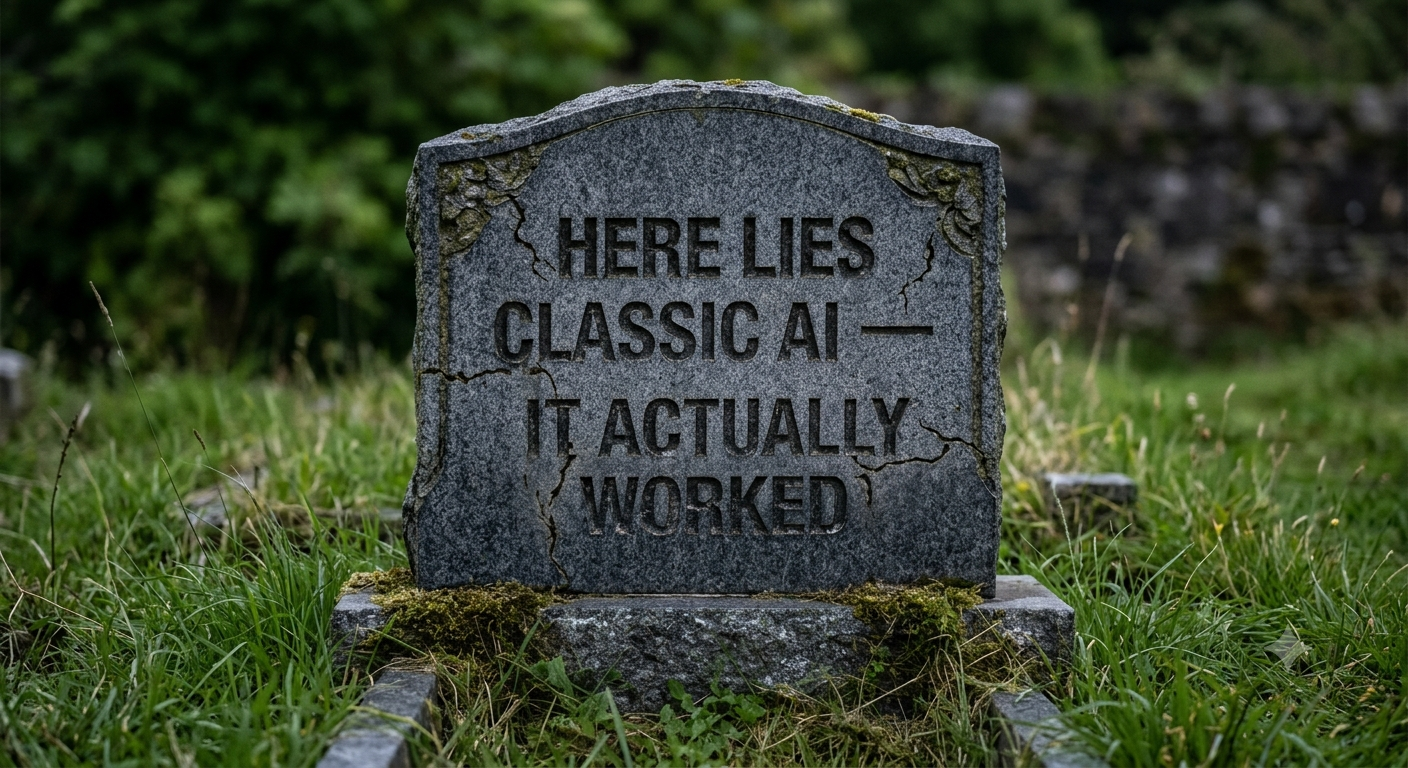
We are burying it with full honors.
The good old AI model.
The one that quietly predicted bearing failures before they happened. The one that spotted scratches no human inspector could see—even at the beginning of a shift, let alone at 2 a.m. after eight hours on the line. The one that reduced downtime, improved quality, and paid for itself without ever asking for applause.
Apparently, it's obsolete. We've even found a name for it: "Classic AI."
Think about that for a second. A convolutional neural network inspecting welds on a production line is now "old school." A gradient-boosted model forecasting equipment failures is "legacy." We've managed to make a technology feel outdated before most factories have even put it into production.
Of course, nobody actually believes predictive maintenance or machine vision no longer work. What's changed is something subtler: "We've stopped talking about them."
Every conference keynote, every board meeting, every vendor presentation now revolves around generative AI and autonomous agents, as if the previous generation of industrial AI had never existed.
Do you think the AI model is dead?
I don't.
Keep reading.
When you think about industrial AI, what comes to mind?
For me, it isn't a chatbot. It's predictive maintenance. It's computer vision. It's process optimization. It's models quietly running at the edge, making thousands of tiny decisions that operators never notice because... nothing went wrong.
None of this is generative AI.
And unlike many of today's headlines, this isn't theoretical. Predictive maintenance has been shown to reduce unplanned downtime by 30–50%, with mature deployments reporting returns of up to 30:1. Computer vision systems can outperform human inspectors on repetitive quality tasks while maintaining consistent accuracy throughout an entire shift.
"This isn't the future. It's Tuesday."
Factories have been generating value with these technologies for years. Yet the AI that's already delivering measurable business outcomes has quietly become "Classic", while the AI still looking for its industrial business case has become the star of the show.
To be fair, there's a reason.
Generative AI feels effortless. Or at least, it promises to.
It arrives pre-trained. It speaks natural language. It demos beautifully.
You can ask questions immediately and get impressive answers without months of preparation.
Classic AI never worked like that. It demanded discipline. You had to define the problem first, then collect data, clean it, realize the data was terrible, collect some more, label thousands of examples, train models, measure performance, start over.
It wasn't glamorous. It was engineering.
Today the promise sounds very different:
"Point an LLM at your industrial data and let it figure everything out."
It's an incredibly attractive vision.
Intelligence without the homework.
Who wouldn't want that?
And this isn't just a marketing claim—we've experienced it firsthand. Thanks to generative AI, our team can accomplish in hours what would have taken us days just a couple of years ago. I use it every single day. It helps me research faster, write faster, and develop ideas more quickly. This article would almost certainly have taken me two or three times longer to write without it. (Sorry to break the illusion, but yes, I had some help.)
But my laptop isn't a factory.
Industrial deployments play by different rules. They require reliable data. Deterministic behavior. Cybersecurity. Offline operation. Hardware expected to remain in service for a decade. And if the AI needs to run at the edge, under the customer's control, the trade-offs become even harder.
Can large language models run locally? Absolutely. We do it ourselves. But today's hardware requirements, model sizes, latency constraints, and costs still make many industrial deployments difficult to justify. Especially when a much simpler model can solve the problem just as well.
And yes, I know what's coming: models will improve, hardware will improve, costs will come down...
But look, here's the thing: Classic AI is already here. It's already deployed. It's already generating measurable value.
Perhaps that's exactly why we've stopped talking about it.
Here's the interesting part.
"This isn't really a story about generative AI."
It's a story about how we adopt technology.
First it was Big Data. Then IoT. Then Blockchain. Do you need a Digital Twin? Oh yes, this changes everything!
Every few years, a new technology arrives promising to solve all our problems. Some eventually solve a few of them. But in the meantime, they usually create a whole new set of problems of their own.
Because hype moves faster than factories. Actually, hype moves faster than almost anything! Business value, however, takes time.
That's exactly what today's numbers suggest. MIT's State of AI in Business 2025 found that the overwhelming majority of generative AI pilots studied had yet to demonstrate measurable P&L impact, despite tens of billions of dollars in enterprise investment. Gartner, meanwhile, expects a significant share of today's agentic AI projects to be scaled back or abandoned over the next few years.
None of this means generative AI has failed. Far from it.
It simply means we're still early. (And yes, I'm writing this in July 2026. I fully expect these numbers to look very different a few years from now.)
But here's the mistake we keep making: Whenever a new technology arrives, we start talking as if everything that came before no longer matters, as if the new tool automatically replaces the old one. But it rarely works that way.
Factories don't become better by chasing the newest technology. They become better by solving real problems with the right technology.
And right now, while generative AI continues to mature, millions of "classic" AI models are quietly doing exactly that.
Here's an uncomfortable idea:
"Maybe you don't need AI at all."
Many of the AI projects I see would probably create more value without AI. Not because AI is bad. Because it's unnecessary.
A solutions architect once told me that after spending nearly a year exploring AI, the biggest operational improvement came from a dashboard and a handful of threshold alerts.
No neural networks, or agents, or copilots. Just better visibility.
It reminded me of a quote commonly attributed to Blaise Pascal:
"I would have written a shorter letter, but I did not have the time."
Good engineering works the same way. The hardest solution to build is often the simplest one. Because it takes discipline to strip away everything you don't need.
That's why the best engineers don't start by asking: "How can I use AI?" They start by asking: "What's the simplest thing that solves this problem?"
Sometimes the answer is an LLM. Sometimes it's a vision model. Sometimes it's a threshold alarm.
And sometimes...
it's just a dashboard.
Generative AI and agentic systems will absolutely earn their place in industry. I'm convinced of that.
But the companies that benefit the most won't be the ones chasing the newest AI at all costs. They'll be the ones that never forgot an engineering principle:
"Start with the problem, then choose the simplest technology that solves it."
Turns out, the obituary was premature.
The good old AI model is still on shift.
Look at it. Still inspecting products. Still predicting failures. Still optimizing processes. Still quietly delivering value.
We thought we were attending its funeral, but it never left the factory floor.
Barbara enables industrial organizations to deploy, orchestrate, and continuously manage distributed applications and AI models directly at the edge — where latency, bandwidth constraints, and data sovereignty cannot be compromised.
Built for complex environments with SCADA systems, PLCs, legacy protocols, and heterogeneous hardware, Barbara helps IT and OT teams move beyond pilots and scale secure edge deployments to thousands of nodes.
If you're working on similar challenges or exploring how edge platforms can support your industrial initiatives, explore more insights on our blog or get in touch with our team to continue the conversation.
Alternatively, you can also start using the platform today.

Most conversations about Agentic AI in industry start three levels too high: autonomous factories, agents talking to other agents. This is the small version that actually works, five building blocks that let an operator ask the plant a question and get a real answer.
.jpg)
Everyone is chasing generative AI and autonomous agents, but the industrial AI that already delivers, predictive maintenance and computer vision, never left the factory floor. A field reality check on hype versus what actually works, and why the best engineering starts with the problem, not the technology.
.jpg)
Most people in industrial automation still believe that hardware is inherently more reliable than software. But many of the assumptions behind that belief were formed decades ago, before connected operations, edge computing, and software-defined industrial systems became a reality. In this article, we challenge five of the most common myths about software in industrial environments.


